
Wildfire Resilience for Critical Infrastructure and Public Assets
The Problem We Solve
Wildfire is no longer a Western U.S. concern. Heat, drought, invasive grasses, and wind are opening new ignition corridors across the Midwest, Appalachia, and the South — regions where infrastructure and the built environment around it were never designed for fire, and where local preparedness is limited.
At the same time, the tools most operators rely on weren’t built to answer the question that matters. Regional hazard maps and catastrophe models estimate where wildfire exposure concentrates across a system. They can’t tell you how an individual asset will actually ignite, which specific vulnerabilities drive that risk, or whether a given mitigation investment will reduce it. That leaves operators making high-stakes capital and resilience decisions on broad assumptions rather than asset-level evidence.


What FortressFire Does
FortressFire’s AMP Platform applies fire physics, machine learning, and ground-level inspection to evaluate wildfire risk one structure at a time. Our proprietary Property Ignition Model (PIM) assesses how each asset will ignite across five specific threat vectors:
- Convective heat
- Radiant heat
- Ember entry
- Ember accumulation
- Structure-to-structure ignition
The result is an objective, comparable basis for decisions across a portfolio: which assets carry the highest ignition risk, where mitigation will have the greatest impact, how risk across your footprint is changing, and — critically — verifiable proof that a completed mitigation has reduced the risk.
Who We Help
Different operators come to FortressFire with different jobs to be done. Our platform supports each:
- Utilities: prioritize where to direct asset-mitigation capital, and document risk-reduction outcomes for regulators and insurers.
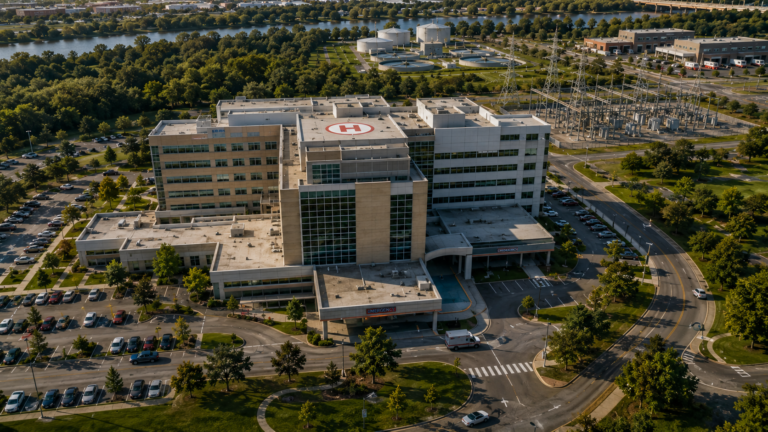
- Critical facility operators (data centers, water and treatment plants, hospitals): ignition-proof the structures behind essential services to protect continuity of operations.
- Public agencies and municipalities: build objective, defensible cases for resilience funding, including FEMA’s Building Resilient Infrastructure and Communities (BRIC) program, the Infrastructure Investment and Jobs Act (IIJA), and state resilience programs.
- Insurers and reinsurers: evaluate infrastructure-adjacent commercial exposure with asset-level precision.
- Brokers: keep large commercial and industrial clients insurable with documented, structure-specific risk management.
Why Infrastructure Fails at the Edges
Substations, transmission structures, control buildings, and critical facilities generally have solid internal protections. They tend to fail because of what surrounds them:
- An outbuilding or shed beneath a transmission line
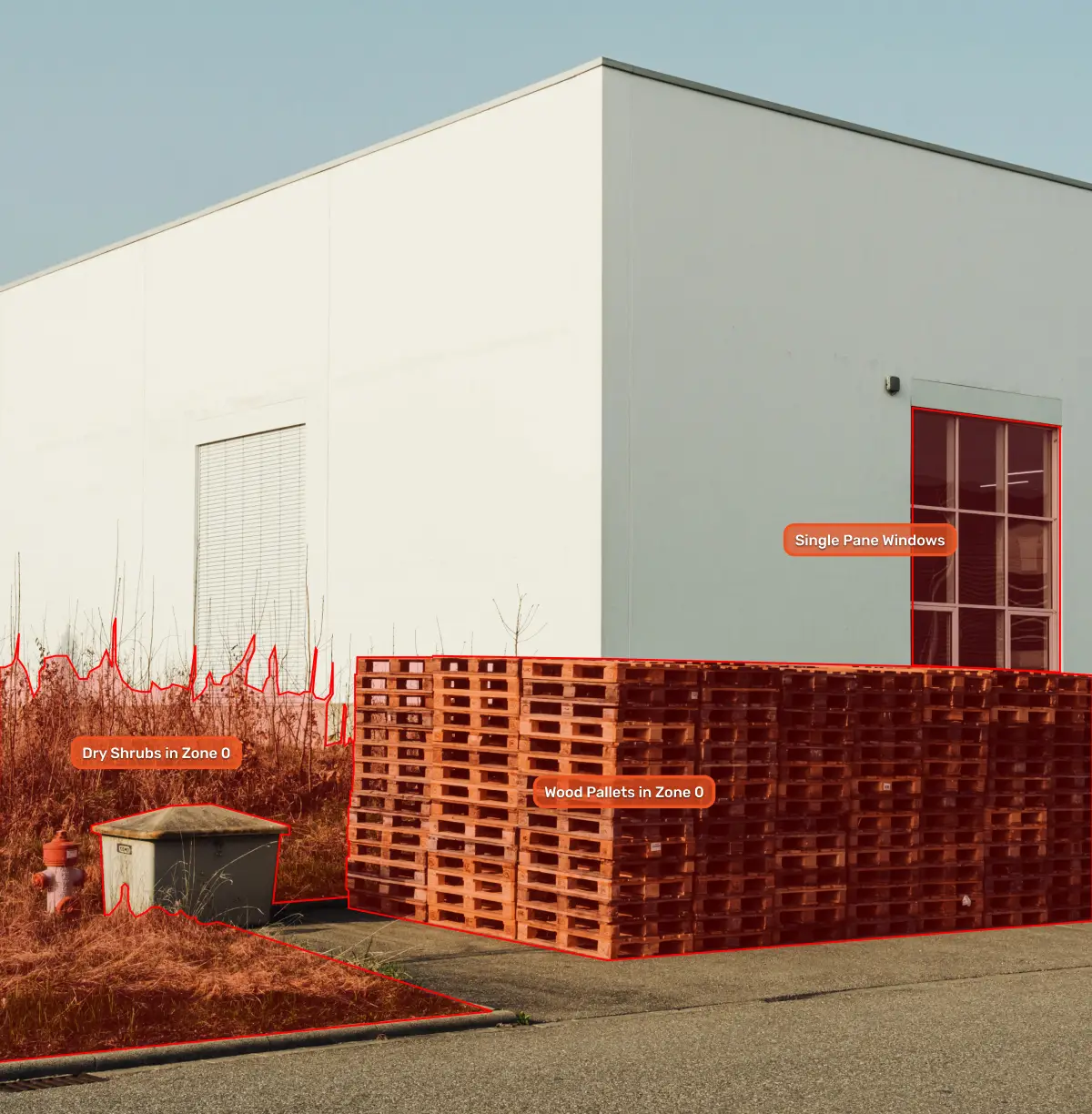
- A wooden fence or combustible siding against a perimeter wall
- Mulch or vegetation in contact with fencing and structures
- A slope that channels radiant heat toward a critical asset
- A structure-to-structure ignition pathway from an adjacent parcel
These edge-zone ignition drivers fall outside traditional grid-hardening programs and macro catastrophe models — and they’re exactly what FortressFire’s structure-level modeling is built to find and fix.
Proof: Same Hazard, Different Ignition Pathways
The same wildfire conditions can hide entirely different vulnerabilities. Our analyses of utility-adjacent infrastructure sites show why ignition intelligence has to operate at the structure level, not just the regional hazard level:
- At one secured site, the surrounding landscape posed little threat. The real vulnerability was structure-to-structure spread between two adjacent buildings inside the operational footprint. Hardening the secondary structure eliminated the transfer pathway — and the modeled vulnerability dropped to zero.
- At another site with no modeled flame or radiant-heat exposure, a single ember-entry point could still have ignited the structure from within. The fix was minimal — ember-resistant screening and vent protection — inexpensive, measurable, and verifiable. The modeled vulnerability again dropped to zero.
Neither vulnerability would surface on a hazard map. Both were remediable through targeted, property-specific mitigation. That’s the difference between knowing where wildfire may occur and understanding how critical infrastructure actually ignites.
How It Works
Assess. Mitigate. Monitor. Protect.
The FortressFire Advantage
- Assess: Physics-based, structure-level evaluation of each asset and the built environment around it.
- Mitigate: A prioritized roadmap targeting the minimum, verifiable actions that eliminate ignition pathways — ready for your own crews and vendors, or sourced through our strategic partners.
- Monitor: Continuous, site-specific tracking of fire-weather, vegetation, fire activity, and ember risk across your operational footprint, with monthly health snapshots and targeted alerts.
- Protect: Actionable intelligence, emergency guidance, and a Strategic Wildfire Emergency Action Plan for each site — with optional Protection Services through partners in select markets.


Resilience You Can Prove
Resilience isn’t achieved when an organization understands wildfire risk in theory. It’s achieved when the conditions required for ignition have been identified and mitigated to prevent loss. FortressFire enables that shift — from broad exposure awareness to actionable, verifiable wildfire resilience — across the assets your communities depend on.
We provide structure-level wildfire ignition intelligence for the assets you manage — substations, water and treatment plants, communications sites, data centers, hospitals, depots, and public buildings. Our platform quantifies each asset’s ignition risk, prioritizes the mitigation that matters most, verifies that risk has been reduced, and monitors your sites continuously.
Get in Touch
Contact us to learn more about our platform, programs, and services.